
联合 EDS-EBSD 表征定向凝固的 Al-Cu-Mg 共晶合金
导言
随着包含增材制造在内涉及凝固的加工技术变得更加流行,凝固在微结构和材料性能发展中扮演的角色也变得越来越重要。基于 Ezemenaka 和 Genau 的论文 (Journal of Crystal Growth 577 (2022) 126389),通过同时采集能量色散谱 (EDS) 和电子背散射衍射 (EBSD),本工作对定向凝固加工的 Al-Cu-Mg 合金进行了表征,以研究此三元共晶合金中形成的物相和取向关系。
结果与讨论
在电炉中熔化具有共晶成分(Al – 15.5 at. % Cu – 10.6 at. % Mg) 的样品,并使用 Bridgman 型炉定向凝固,控制凝固条件以建立稳定的微观结构生长模式。此处给出的示例来自于一个生长高度为 49 mm 的样品。用于 EBSD 分析的是平行于凝固方向的横截面,制备时首先通过机械抛光至0.1 µm 金刚石抛光膏,然后在振动抛光机上用 0.05 µm 胶体二氧化硅抛光 2 小时。最终的 EBSD 制样是使用 PECS™ II 宽束离子抛光仪通过 2 步研磨程序进行的。 样品首先用 4° 掠射角的 4 kV 氩束研磨 10 分钟,然后用 4° 掠射角的 2 kV 束研磨 60 分钟。
EBSD 数据通过 EDAX® Clarity™ 直接探测器采集,加速电压20 kV,束流大约 1 nA。 EDS 数据则通过 Octane Elite 探测器与 EBSD 数据同步采集。样品的微观结构如图 1 中三个 EDAX PRIAS™ 图像所示。
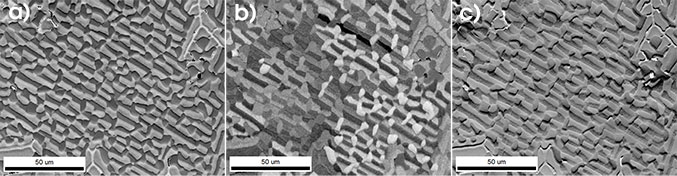
Figure 1. a) PRIAS top ROI image showing atomic number contrast, b) PRIAS middle ROI image showing orientation contrast, and c) PRIAS bottom ROI image showing topographic contrast for the directionally solidified Al-Cu-Mg alloy.
图 1a 显示了样品的原子序数衬度,来源于PRIAS 图像的顶部感兴趣区域 (ROI)。图 1b 是PRIAS 中部 ROI 图像,显示了来自不同晶粒和物相的取向衬度。图 1c 突出显示了制备后样品上存在的表面形貌,来源于 PRIAS 图像的底部 ROI。这种多相样品呈现出表面形貌是因为组成相具有不同的抛光速率。

EDS 信息用于 ChI-Scan™ 分析,以获得更准确和有效的相分布,如图 3 所示。在 ChI-Scan 标定过程中,还应用了 NPAR™ 以提高保存的 EBSD 花样和后续标定结果的信噪比。相图显示了在这种三元共晶合金中所预期的标准两层/一棒图案。Al 和 Al2CuMg 相形成层状相,Al2Cu 形成棒状相。使用此 EBSD 数据,可以轻松测量每个相的晶粒尺寸和形态。同时,还检测到了另一种带核的 Al-Si-Mg 相,归因于未知来源的污染。

Al、Al2CuMg 和 Al2Cu 相的反极图 (IPF) 图如图 4 所示,取向着色相对于分析表面的法向进行。这些取向图显示了每个组成相的一个强择优取向。
对这些取向的分析表明,Al相的 [001] 晶向平行于Al2Cu的 [001] 晶向,也平行于 Al2CuMg 相的 [100] 方向。这些取向关系可以通过在每个相的反极图中绘制彩色取向来可视化,如图 5 所示。有趣的是,通过比较图 3 和图 4,可以观察到毗邻带核 Al-Si-Mg 相的 Al 晶粒具有偏离于其他晶粒以及预期取向关系的取向。
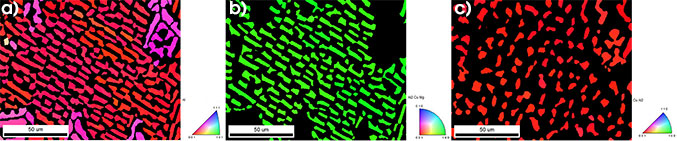
Figure 4. IPF orientation maps for the a) aluminum, b) Al2CuMg, and c) Al2Cu phases, with the orientations colored relative to the surface normal direction of the measured surface.
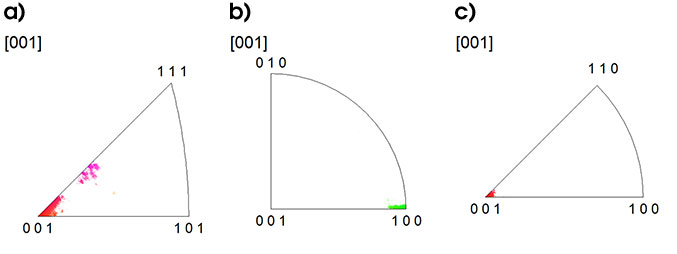
Figure 5. IPF plots for the a) aluminum, b) Al2CuMg, and c) Al2Cu phases, with the orientations colored using the same color scheme from Figure 4.
小结
本工作展示了如何联合 EDS 和 EBSD 来充分表征通过定向凝固制备的复杂三元共晶合金中存在的取向和取向关系。使用 Clarity、Octane Elite、ChI-Scan 和 NPAR 处理,可以从每个存在的相中获得最佳的 EBSD 花样标定,以获得准确的结果。由衷感谢阿拉巴马大学伯明翰分校(之前)和阿拉巴马大学(现在)的 Dominic Ezemenaka 提供样本以及共享 EBSD 数据。