
Improve the indexing rate – The EDAX optimized EBSD solution
Dr. Sophie Yan, Applications Engineer, Gatan
As an applications specialist, I have encountered various problems over the years. There is always a common goal among electron backscatter diffraction (EBSD) users—to improve the EBSD indexing rate. Even a user who mainly tests relatively easy steel samples may run into deformed samples and intergranular precipitates that are difficult to calibrate, so they still need to improve the indexing rate. Ideally, we want to get a beautiful EBSD inverse pole figure (IPF) map like Figure 1; however, the reality is that we often fail to get a map with such a high indexing rate.

Recently, I received a phone call from a customer asking for help. She had tricky ceramic samples with low crystallinity and fine grains, which are hard to index. The indexing success rate was only 5.48% from the area she tried to analyze (Figure 2). She wanted to see if we could improve it.

Of course, we can.
EDAX® has a set of solutions to improve the indexing rate, as shown in Figure 3. If I had a direct detector like the EDAX Clarity™ EBSD analysis system, I would obviously get better results. However, I only have a CMOS-based EDAX Velocity™ Super in my lab.
During the data collection process, users can optimize different parameters, such as background processing, or Hough parameters, to fit real-world samples. Combined with a unique hexagonal grid sampling and triplet indexing solution, EDAX gets a better indexing rate, which is very important for challenging samples.
If the data is not ideal, we can process the result using EDAX NPAR™. With NPAR, it averages the patterns to improve the indexing rate of challenging samples considerably. Also, in EDAX OIM Analysis™ v8.0 or higher, a module is available that can perform background processing again on the saved patterns to improve the indexing rate further.
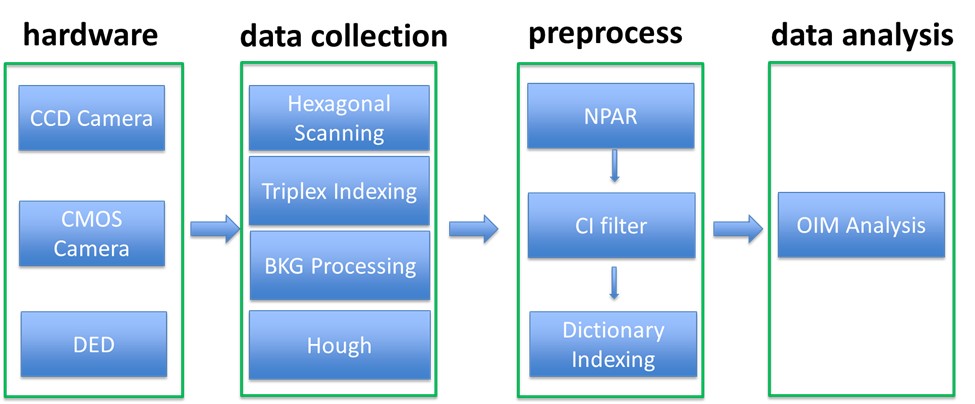
Figure 3. EDAX optimized EBSD solution.
I analyzed the sample and saved the patterns. Then I used OIM Analysis to post-process the patterns, as shown in Figure 4. The original pattern is quite fuzzy, and the bands were not clear. After NPAR processing, it improves the signal-to-noise ratio of the pattern, and the bands became clearer after further background processing.

Of course, the processed patterns have indexing success rates. Figure 5 shows the IPF map of the data after a series of post-processing steps were taken, as described in Figure 4. The indexing success rate improved to 24.1%.

For this user’s case, the indexing success rate was greatly improved and was within an acceptable range. But to achieve our goal of improving the indexing rate of challenging samples, there is much more that needs to be done.
The above indexing success rates were achieved after CI >0.1 filtering. For those points with a CI <0.1 (the black areas in the IPF map), we can further process them. EDAX recently added OIM Matrix™, which includes dictionary indexing as a supplementary solution. As we all know, the result of dictionary indexing is usually better. I would expect a higher indexing success rate on the customer sample if I could use dictionary indexing to process it further.
If we push the limit, we can use the Clarity system to test this sample. In fact, the super-sensitive, low-beam current requirement is ideal for testing this type of sample. Maybe we can expect a better result with Clarity?
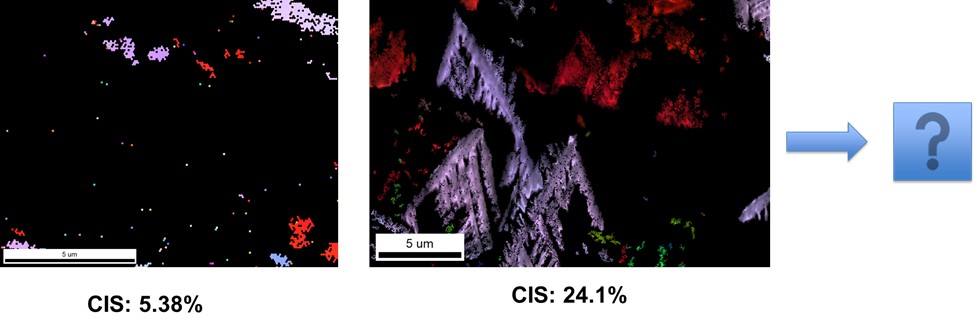
Figure 6. Will the result improve with Clarity?
The goal of improving the indexing rate can be summed up in one sentence from a Chinese poem published in roughly 300 BC: The journey is long, but I will search up and down.